Action Hero: A Deep Dive into the Grungy Brush Font for High-Impact Titles
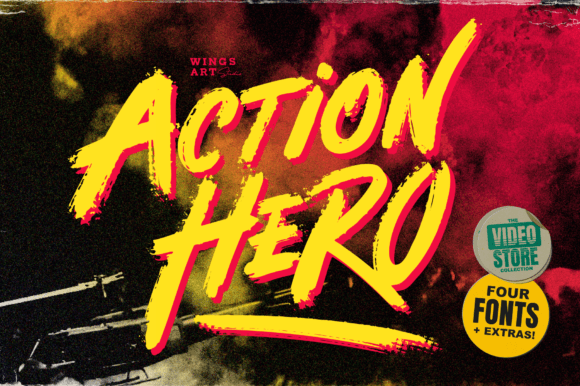
In the landscape of graphic design, typography is often the silent communicator of tone. When a project demands urgency, grit, and a sense of impending action, the choice of typeface becomes critical. Action Hero is a specific entry in the category of display typefaces, characterized as a hand-drawn brush font. It draws direct inspiration from the aesthetic of 1980s and 1990s action movie posters—think bold strokes, textured edges, and a sense of raw energy.
For designers evaluating typography for movie posters, video game titles, or thematic branding, understanding the technical and aesthetic nuances of a font like Action Hero is essential. This article explores the features, use cases, and considerations for deciding if this typeface aligns with your project goals.
Defining the Action Hero Aesthetic
Action Hero is not a standard sans-serif or serif font. It falls into the category of display typefaces, specifically designed for headlines and logos rather than body copy. Its defining characteristic is the "grungy" texture. This implies that the strokes of the letters are not perfectly smooth; they mimic the imperfections of ink on paper or paint on a canvas.
The design philosophy behind Action Hero is rooted in cinematic nostalgia. The font family attempts to replicate the hand-lettering styles often seen on VHS covers and theatrical one-sheets from the era of high-octane blockbusters. It is a stylistic choice meant to evoke a specific mood: tension, confrontation, and excitement.
Situational Fit: When to Choose Action Hero
Evaluating whether Action Hero fits your project requires looking at the narrative context of your design. The font is engineered for scenarios that require a visceral, physical feel.
Ideal Scenarios
- Cinematic Titles: If you are designing a poster for a film involving high-stakes scenarios—such as a thriller involving a hostage situation on a speeding train or a post-apocalyptic survival story—the font’s gritty aesthetic supports the narrative tension.
- One-Sheet Design: For movie posters, particularly within the thriller, horror, or action genres, Action Hero provides the necessary visual weight to anchor a composition.
- Game UI and Art: Video games that feature retro aesthetics or intense combat scenarios can benefit from this font style for menu headers or title screens.
- Thematic Branding: Specific events, such as haunted houses, obstacle course races, or themed merchandise, where the goal is to convey "toughness" or "danger."
Less Suitable Scenarios
Conversely, Action Hero is likely not the right tool for corporate reports, legal documents, or luxury branding that requires sleek minimalism. Its textured nature can clash with clean, professional environments or make text difficult to read at small sizes.
Technical Features and Creative Flexibility
One of the primary differentiators for Action Hero compared to other brush fonts is its implementation of OpenType features. A common frustration with hand-drawn fonts is repetition. When typing a word like "ASSASSIN," seeing the exact same shape for every 'S' and 'A' breaks the illusion of hand-lettering, making the text look artificial.
Action Hero addresses this through extensive character mapping and alternates. The font family includes creative options that allow designers to swap characters. This ensures that no two letters appear identical in close proximity, achieving a more authentic, organic look.
Evaluating the Benefits
When assessing the value proposition of Action Hero, consider the following advantages:
- Authenticity: The texture and irregularity of the strokes provide an immediate "hand-made" feel that standard vector fonts struggle to replicate without extensive manual editing.
- Visual Impact: The heavy weight and high contrast of the letterforms ensure that titles command attention immediately.
- Character Variation: The inclusion of alternate characters is a significant functional benefit, preventing the "digital look" that ruins the immersion of hand-drawn styles.
Tradeoffs and Considerations
While Action Hero offers distinct stylistic advantages, there are practical tradeoffs to consider during the selection process.
- Readability: As with many high-texture display fonts, legibility can be an issue at smaller sizes. The "grungy" elements that look good on a large poster title may turn into visual noise on a business card or mobile screen.
- Contextual Mismatch: The strong association with 80s/90s action movies means the font carries a lot of cultural baggage. Using it for a serious documentary or a children's book might create a tonal dissonance.
- File Complexity: Fonts with many alternates and high-resolution textures can sometimes be larger in file size or more demanding on rendering engines than simple vector fonts, though this is rarely an issue for static design work.
Decision-Making Insights
To determine if Action Hero is the correct choice for your workflow, ask the following questions:
- What is the primary medium? If the final output is large format print (posters, banners) or high-resolution digital art, the texture will shine. If the output is small text or low-resolution web headers, the details may be lost.
- What is the desired emotional response? Action Hero is designed to elicit excitement and tension. If the goal is calm, trust, or elegance, this font will work against you.
- How important is realism? If you want the title to look like it was painted by a human on set, the alternates provided by Action Hero are a strong technical solution.
Conclusion
Action Hero is a specialized tool designed for a specific aesthetic niche. It excels in creating title designs that feel explosive, textured, and rooted in the cinematic styles of the late 20th century. For designers working on movie posters, gaming assets, or thematic typography where grit and energy are paramount, it offers a robust set of features, including character alternates that solve common problems associated with digital brush fonts.
However, like all display fonts, it requires context. Its effectiveness is maximized when paired with appropriate imagery and used at scales where its texture enhances rather than hinders readability. By weighing these factors against your project's specific needs, you can determine if Action Hero is the right addition to your typographic arsenal.