Bright Harvest: Balancing Modern Flair with Slab Serif Stability
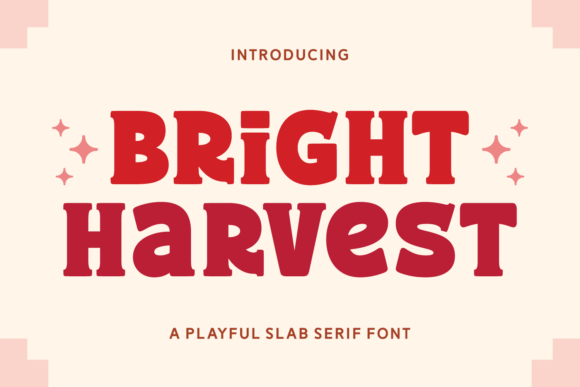
In the crowded landscape of typography, selecting the right typeface often feels like a compromise between personality and performance. Designers frequently struggle to find fonts that offer the structural integrity required for corporate branding while retaining a creative spark that captures attention. Bright Harvest emerges as a compelling contender in this space, presenting itself as a stylish and modern slab serif font. It aims to bridge the gap between classic elegance and contemporary flair, offering a solution that works across various mediums without sacrificing aesthetic appeal.
Understanding the Anatomy of Bright Harvest
To appreciate the utility of Bright Harvest, one must first understand its design philosophy. At its core, the font utilizes the slab serif classification—characterized by thick, block-like serifs—but updates the formula with cleaner lines and a balanced structure. Unlike traditional slab serifs, which can sometimes feel heavy, industrial, or dated, Bright Harvest introduces a smoothness to its curves and terminals. This results in a typeface that feels remarkably modern while maintaining the grounded, authoritative presence typical of the genre.
The distinctiveness of Bright Harvest lies in its versatility. It is not merely a decorative font intended for isolated use; rather, it is designed to function effectively in both print and digital environments. The letterforms are constructed with attention to negative space, ensuring that the font remains legible even at smaller sizes or lower resolutions. For designers evaluating typography, this balance is crucial: a font must be expressive enough to build a brand identity but neutral enough to not distract from the message.
Comparing Bright Harvest to Other Serif Styles
When exploring typography options, it is helpful to categorize fonts by their intended function and visual weight. Bright Harvest sits comfortably between the extremes of delicate hairline serifs and heavy, vintage display types.
- Compared to Traditional Serifs: Fonts like Times New Roman or Garamond are optimized for long-form body text. While elegant, they often lack the visual impact required for bold headlines. Bright Harvest, with its robust weight and clean geometry, is designed to stand out. It is less about disappearing into the text and more about commanding the viewer's immediate attention.
- Compared to Sans-Serifs: Sans-serifs are often chosen for their modern, minimalist look. However, they can sometimes lack "warmth" or gravitas. Bright Harvest offers a modern aesthetic similar to a geometric sans-serif but retains the "anchoring" effect of serifs, which can guide the eye and suggest stability.
- Compared to Rustic or Vintage Slabs: Many slab serifs lean into a "Wild West" or industrial vibe. Bright Harvest avoids these nostalgic tropes. Its smooth design suggests a contemporary, polished environment, making it a safer choice for modern corporate branding or sleek editorial design.
Best-Fit Scenarios: Where Bright Harvest Excels
Evaluating a font requires looking at specific use cases to determine if the tool fits the project. Bright Harvest’s design suggests it is particularly well-suited for scenarios where a statement needs to be made without appearing aggressive.
Branding and Logos
For logos, memorability is key. The clean lines of Bright Harvest ensure that a logo remains recognizable whether it is printed on a business card or scaled up on a billboard. It projects a sense of reliability and modernity, which is ideal for startups, lifestyle brands, or agricultural businesses that want to appear fresh yet established.
Editorial and Poster Design
In the realm of editorial design, contrast is essential. A magazine layout or a poster often requires a font that can handle large-scale typography. Bright Harvest’s balanced structure allows it to fill space effectively without looking blocky. It pairs well with lighter, sans-serif body text, creating a visual hierarchy that draws the reader in.
Digital Media and Web Headlines
On screens, legibility is paramount. The "smooth" quality of Bright Harvest mentioned in its design brief suggests optimized rendering for digital displays. It avoids the jagged edges that can plague some serif fonts at low resolutions, making it a viable option for website headers and mobile app interfaces where clarity is non-negotiable.
Tradeoffs and Limitations
No typeface is a universal solution, and an honest evaluation of Bright Harvest must acknowledge where it might fall short. Understanding these tradeoffs helps in making an informed decision.
- Long-Form Text: While Bright Harvest offers excellent readability for headlines, slab serifs are generally not the optimal choice for large blocks of body copy (such as 10-point text in a book). Their heavy serifs can create visual clutter over long paragraphs. For body text, pairing Bright Harvest with a standard serif or sans-serif is recommended.
- Ultra-Minimalist Design: If a project requires extreme minimalism—such as a high-fashion brand that relies on negative space and whisper-thin typography—Bright Harvest’s robust presence might feel too substantial. In such cases, a light-weight sans-serif might be more appropriate.
- Formal Academic Contexts: For highly traditional academic papers or legal documents where convention is strictly enforced, a modern slab serif might be viewed as too "stylish." Traditional book faces are usually preferred in these rigid environments.
Decision Factors: Is Bright Harvest Right for You?
When choosing between Bright Harvest and other alternatives, consider the personality of your project. Typography is a form of non-verbal communication; different fonts "speak" with different tones.
Choose Bright Harvest if:
- You need a font that feels authoritative but not old-fashioned.
- Your project involves a mix of digital and print media, requiring high adaptability.
- You are designing bold statements, such as quotes or call-to-action buttons, where legibility and impact are paramount.
- You want to evoke a sense of harvest, growth, or groundedness with a modern twist.
Consider alternatives if:
- You are strictly designing long-form novels (opt for a transitional serif).
- The brand voice is purely whimsical or hand-drawn (opt for a script font).
- The design system already has a heavy display font, and you need a subtle background player.
Practical Application and Pairing
For designers looking to integrate Bright Harvest into their workflow, the key is pairing. Because Bright Harvest has a distinct style, it benefits from contrast. A common strategy is to pair it with a neutral sans-serif for subheadings and body text. This allows Bright Harvest to handle the "heavy lifting" of the visual hierarchy while the supporting font carries the detailed information.
Furthermore, testing the font in various weights is essential. A font described as "smooth" often implies a good range of weights, allowing for flexibility in creating depth within a design without introducing a second typeface family.
Conclusion
Bright Harvest represents a specific niche in the typography market: the modernized classic. It acknowledges the enduring appeal of the slab serif while stripping away the dated elements that can make such fonts feel heavy. For designers, marketers, and brand builders, it offers a tool that is visually striking, highly readable, and adaptable to a variety of media. By weighing its bold character against the specific needs of a project, one can determine if Bright Harvest is the harvest worth reaping. It stands as a testament to how traditional structures can be reimagined to meet contemporary design challenges.