The Unspoken Bond in Design: Harnessing the Power of Camaraderie
In the vast and often sterile digital landscape, where precision and uniformity frequently dominate, there exists a profound yearning for authenticity. We navigate interfaces built on grids and vectors, yet our human brains crave the imperfections of the organic world. This is where the concept of camaraderie—a spirit of friendly good-fellowship—translates from a social interaction into a visual language. In the realm of typography and graphic design, this feeling is most potently captured by typefaces that refuse to be rigid. Among these, the Camaraderie font stands out as a distinct tool for creators seeking to bridge the gap between the digital and the handwritten.
The Psychology of the "Imperfect" Line
Understanding why a font like Camaraderie resonates requires a look at visual psychology. Humans are wired to recognize patterns, but we are emotionally moved by nuance. A perfectly geometric sans-serif font suggests efficiency, modernity, and corporate structure. Conversely, a handwritten script suggests a human presence behind the message. When a viewer sees text that mimics the flow of ink on paper, their brain processes it not just as information, but as a conversation.
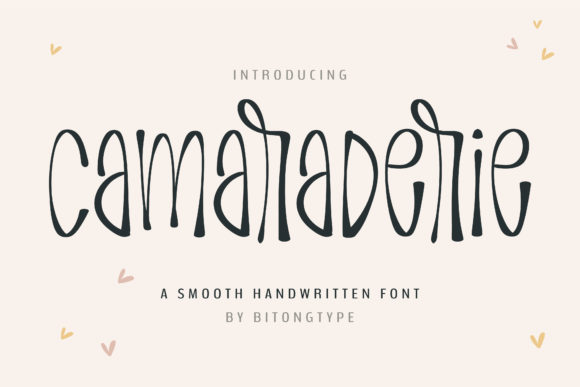
The Camaraderie typeface leverages this by offering a "sweet and a bit quirky" aesthetic. It does not attempt to replicate the formal calligraphy of a wedding invitation or the aggressive scrawl of a doctor’s prescription. Instead, it occupies a unique middle ground. It feels like a note passed between friends or a journal entry. This specific visual tone lowers the barrier between the creator and the consumer, fostering an immediate sense of trust and relatability.
Anatomy of the Aesthetic
What defines the visual structure of Camaraderie? To the untrained eye, it may simply look like "messy" writing, but to a designer, it represents a complex set of choices regarding baseline shifts and stroke width. The font possesses a natural irregularity that is crucial for avoiding the "uncanny valley" of script fonts—where type looks too computerized to be hand-drawn, yet too erratic to be formal.
- Organic Flow: The letterforms connect in a way that mimics the natural lifting and placing of a pen. This creates a rhythm that guides the eye smoothly across the page.
- Variable Weight: Unlike monoline technical fonts, Camaraderie often features subtle variations in thickness, adding depth and texture to the text.
- Legibility at Scale: Despite its decorative nature, the font maintains a surprising level of clarity. This balance is essential for branding, where logos must be recognizable even when scaled down to a favicon or scaled up to a billboard.
Real-World Applications: Beyond the Logo
While many designers initially view handwritten fonts as strictly for logos or headers, the utility of Camaraderie extends far beyond simple branding marks. Its versatility allows it to function as a key player in various design ecosystems, provided the designer understands the context of the medium.
Editorial and Publishing
In the world of independent publishing and magazines, pull quotes are used to break up long blocks of text and highlight key insights. Using Camaraderie for these elements creates a stark, beautiful contrast against a clean serif or sans-serif body copy. It draws the reader's eye and emphasizes the quote as a moment of personal reflection or emphasis.
Packaging and Product Design
Consider the shelf appeal of artisanal goods. A coffee label, a jar of organic jam, or a hand-poured candle relies on the perception of care. The Camaraderie font signals to the consumer that the product was crafted with attention to detail. It suggests that there is a person, not just a machine, behind the product. This is particularly effective for brands targeting the "maker movement" or eco-conscious consumers who value transparency and human touch.
Digital User Interfaces (UI)
Using handwritten fonts in UI design is a delicate art. They should rarely be used for body text or navigation buttons due to readability concerns on low-resolution screens. However, in "empty states"—the screens shown when a user has no data to display, such as an empty shopping cart or a blank document—Camaraderie can soften the blow. A friendly, handwritten message saying "Nothing here yet!" feels far more welcoming than a stark, robotic error message.
The Educational and Instructional Angle
Educators and content creators face a unique challenge: making dense information digestible. The "schoolhouse" aesthetic is making a comeback in modern design, particularly in e-learning platforms and educational YouTube channels. Using Camaraderie in presentation slides or instructional infographics can mimic the experience of a teacher writing on a whiteboard.
This approach serves a functional purpose beyond aesthetics. It helps to segment information. When students see the Camaraderie font, they can intuitively understand that this text represents a side note, a fun fact, or a personal anecdote from the instructor, distinguishing it from the core curriculum data. It creates a visual hierarchy that aids in memory retention.
Strategic Implementation for Business Owners
For business owners and marketing professionals, adopting a typeface like Camaraderie is a strategic decision that defines brand voice. However, implementation requires restraint. A common pitfall is "font soup," where too many different typefaces compete for attention, resulting in a chaotic visual identity.
To effectively integrate Camaraderie, one should adhere to the rule of three: a primary font for body text (clean and legible), a secondary font for headers (bold and structural), and a tertiary font for accents (where Camaraderie shines). This hierarchy ensures that the "quirky" nature of the font enhances the design rather than overwhelming it.
Technical Considerations and Pairing
The success of a handwritten font often depends on its neighbors. Because Camaraderie is expressive and organic, it pairs best with typefaces that are neutral and geometric. Pairing it with another decorative font will result in visual clutter. Instead, look for strong geometric sans-serifs like Montserrat, Futura, or Poppins. These fonts provide the rigid structure that allows the fluidity of Camaraderie to pop.
Furthermore, color plays a significant role. Handwritten fonts often carry a "heavy" visual weight due to their complex shapes. Using Camaraderie in a solid black on a stark white background can sometimes feel harsh. Experimenting with softer neutrals—charcoals, navy blues, or earth tones—can help the font settle into the design more naturally, reinforcing the organic vibe it projects.
The Future of Human-Centric Design
As artificial intelligence continues to generate hyper-realistic imagery and perfectly optimized layouts, the value of human imperfection will only increase. We are entering an era where "perfect" is becoming cheap, and "authentic" is becoming premium. The Camaraderie typeface represents a small but significant rebellion against the algorithmic nature of modern design.
It reminds us that design is ultimately about communication between people. Whether it is used on a wedding invitation, a mobile app, or a corporate brand refresh, the font carries a message that transcends the words it spells out. It tells the viewer that there is warmth, personality, and a shared understanding present. In a world of high-tech precision, the sweet, quirky touch of Camaraderie might just be the most sophisticated tool in a designer's arsenal.