The Psychology of Playful Typography: Unpacking the Design of Funky Truth
In the vast ecosystem of digital typography, where sans-serifs dominate corporate branding and serifs rule the editorial world, there exists a specialized niche dedicated to emotional resonance through letterforms. This niche is the domain of display typefaces—fonts designed not just for legibility, but for atmosphere. Within this sphere, Funky Truth stands as a quintessential example of how type can transcend mere text to become a visual representation of joy, camaraderie, and whimsy. Understanding the mechanics and the psychology behind such a typeface is essential for designers, educators, and content creators looking to evoke specific emotional responses in their audience.
Anatomy of Whimsy: Deconstructing the Letterforms
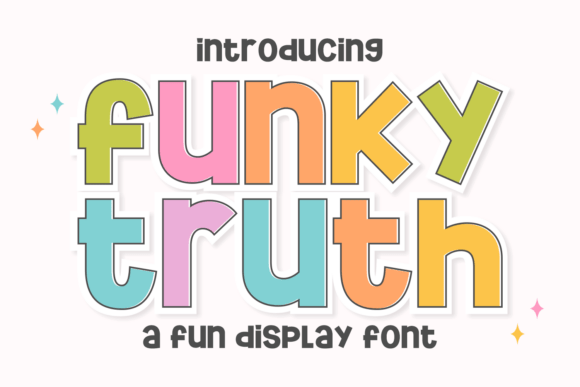
To appreciate Funky Truth, one must look beyond the surface aesthetic and examine the structural anatomy of the font. Unlike rigid geometric types, the defining characteristic of this typeface is its fluidity. The architecture of the letters relies heavily on soft curves and rounded terminals. There are no sharp serifs or abrupt angles; instead, the strokes taper gently or round off into bulbous, friendly endpoints. This lack of sharpness is a deliberate design choice rooted in color psychology and shape recognition. Sharp angles often trigger subconscious associations with danger or aggression, whereas curves are associated with safety, nature, and organic life.
The weight distribution in Funky Truth often mimics the pressure of a felt-tip marker or a soft brush. This creates a "warm" texture on the page, suggesting a human touch rather than the cold precision of a vector algorithm. The x-height—the height of the lowercase letters—is typically generous, which enhances readability while maintaining a compact, toy-like appearance. This structural decision makes the font feel approachable to readers of all ages, bridging the gap between adult sophistication and childhood innocence.
The Emotional Architecture: Warmth and Congeniality
Typography is a silent ambassador of brand voice. When a designer selects Funky Truth, they are making a conscious decision to project an image of affability and openness. This is particularly relevant in the context of "feminine grace" within design, a term that in this application refers not to gendered marketing, but to a design philosophy emphasizing elegance, softness, and nurturing aesthetics.
The temperament of the font evokes sentiments of friendship. Consider the difference between a legal contract set in a stiff serif and a greeting card written in a playful script. The latter immediately lowers the reader's psychological defenses. In user experience (UX) design, this is known as reducing cognitive friction. By utilizing a font that looks like it is smiling, creators can make content feel less like a demand for attention and more like an invitation to engage. This "affable temperament" is crucial for industries focused on care, creativity, and community.
Visual Rhythm and Flow
The rhythm of Funky Truth is syncopated rather than metronomic. Where standard text fonts strive for a consistent gray value across a block of text, display fonts like this one celebrate the individuality of each character. The kerning (spacing between letters) is often adjusted to allow for breathing room, preventing the text from feeling cluttered. This visual rhythm mimics the cadence of happy conversation, reinforcing the theme of camaraderie.
Strategic Applications: Where Funky Truth Shines
While versatility is a virtue in typography, Funky Truth is a specialist. It excels in environments where emotional connection is prioritized over information density. Its utility can be categorized into several key areas, each leveraging the font’s unique properties to achieve specific communication goals.
Children’s Educational Materials
The primary and perhaps most potent application of Funky Truth is in the creation of children’s books and educational resources. For early learners, typography is not just about reading; it is about decoding shapes. The rounded, distinct nature of this font aids in letter recognition. Furthermore, the "fun" element reduces the anxiety often associated with learning to read. When a child encounters a page that looks playful, the task of reading feels like a game rather than a chore. Educators can use this font to create worksheets, flashcards, and classroom signage that fosters a positive learning environment.
Festive Invitations and Event Branding
The second major application lies in the event industry. Funky Truth is the perfect fit for festive invitation designing. Whether it is a whimsical wedding, a baby shower, a milestone birthday, or a community festival, the font sets the mood instantly. Its inherent energy suggests celebration. In the context of invitations, the font does half the work of the copywriter; it tells the recipient that the event will be relaxed, enjoyable, and filled with warmth before they even read the details of the venue.
Creative Projects and Artistic Expression
Beyond commercial use, Funky Truth serves as a tool for artists and hobbyists. In scrapbooking, digital art, and mixed-media projects, the font acts as a decorative element in its own right. It is often used to create headers that mimic hand-lettering, providing the charm of manual calligraphy with the consistency of digital typesetting. This is particularly useful for creators who want to maintain a consistent aesthetic across a series of prints or social media posts without spending hours on manual rendering.
The User Experience: Bridging the Gap Between Professional and Consumer
One of the most challenging aspects of modern design is creating content that appeals to both professional standards and consumer desires. Funky Truth acts as a bridge in this regard. For business owners, particularly those in the lifestyle, wellness, or childcare sectors, the font offers a way to appear professional yet personable. It avoids the sterility of corporate branding while steering clear of the illegibility often found in overly artistic scripts.
For the consumer, the font represents trust. In a market saturated with aggressive marketing tactics, a design that utilizes Funky Truth signals a brand that values connection over conversion. It suggests that the business is run by humans who care about the customer experience. This subtle psychological cue can significantly impact brand loyalty and customer retention, particularly in service-based industries.
Technical Considerations and Implementation
While the aesthetic of Funky Truth is its selling point, practical implementation requires technical awareness. Display fonts, by nature, are not designed for body text. Using this typeface for long paragraphs would result in eye strain due to its decorative complexity. Therefore, the hierarchy of the design is paramount.
- Headlines and Titles: This is the natural habitat of Funky Truth. It should be used at large point sizes where the details of the curves and terminals can be fully appreciated.
- Pairing Fonts: To maintain readability, Funky Truth should be paired with a neutral, clean sans-serif or a simple serif for body copy. The contrast between the playful headline and the structured body text creates a balanced visual weight.
- Color and Spacing: Because the font has a strong personality, it pairs well with bright, optimistic color palettes. However, care must be taken with tracking (letter spacing). Too tight, and the letters will collide; too loose, and the word shape disintegrates.
Trends in Typography: The Shift Toward Authenticity
The popularity of typefaces like Funky Truth reflects a broader trend in the design world: the shift toward authenticity and imperfection. For years, design was dominated by Swiss minimalism and grid-based perfection. However, the digital age has brought a craving for the "human touch." We see this in the rise of hand-drawn logos, textured backgrounds, and, of course, whimsical display fonts.
Funky Truth fits perfectly into this zeitgeist. It acknowledges that communication is not just about the transfer of data, but the transfer of emotion. In an era of AI-generated content and algorithmic feeds, a typeface that looks hand-crafted and joyful offers a refreshing return to human-centric design. It reminds us that behind every message is a person, and behind every design choice is an intent to connect.
Conclusion: The Enduring Value of Joyful Design
In summary, Funky Truth is more than just a collection of vectors; it is a design strategy. Its cheerful curves and warm temperament make it an indispensable tool for anyone looking to foster a sense of warmth, congeniality, and delight. From the pages of a child’s first book to the header of a festive invitation, it proves that typography has the power to shape our emotional reality. For designers and creators, embracing such fonts is an acknowledgment that in a complex world, a little bit of whimsy is not just nice to have—it is essential.