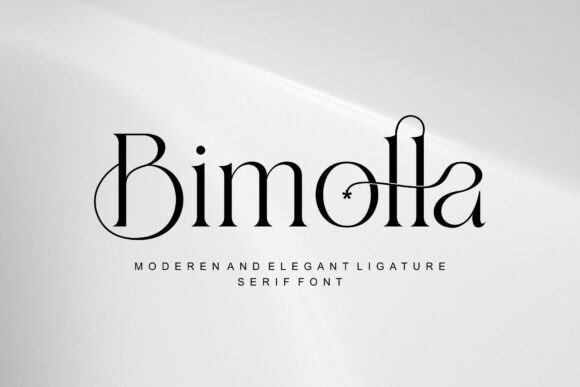
Understanding Bimolla: A Detailed Evaluation for Design Professionals
In the competitive landscape of typography, the selection of a typeface is a critical decision that influences brand perception and user experience. Bimolla represents a specific category within modern design: the luxury minimal modern logo serif font. This typeface is crafted to meet the needs of designers seeking a balance between traditional elegance and contemporary simplicity. It is not merely a set of characters but a tool designed to convey sophistication through smooth curves, graceful alternates, and delicate ligatures.
The primary function of Bimolla is to provide versatility in high-end visual communication. Its design philosophy centers on "luxury minimalism," a style that avoids excessive ornamentation while maintaining a distinct presence. This approach makes it suitable for applications where clarity and class are paramount. The typeface features balanced proportions and elegant strokes, allowing it to function effectively across different contexts, from prominent headlines to refined body text.
Evaluating the Design Characteristics of Bimolla
When assessing Bimolla, it is helpful to examine its core design attributes. The typeface is characterized by smooth, flowing curves that contribute to a sense of fluidity and modernity. These curves are balanced with structured letterforms, ensuring legibility even at smaller sizes. The inclusion of graceful alternates and ligatures offers designers creative flexibility, enabling customized typographic compositions that can elevate a design project.
The "serif" classification indicates that Bimolla includes small strokes at the ends of its main letter strokes. However, its design leans towards a modern interpretation, where serifs are often refined and understated. This positions it between classic serif fonts and modern sans-serifs, offering a hybrid aesthetic. The "minimal" aspect suggests that decorative elements are used sparingly, focusing instead on clean lines and open spacing.
Primary Use Cases and Ideal Applications
Bimolla is engineered for specific design scenarios where its attributes can be most effectively leveraged. Its elegant and sophisticated character makes it a strong candidate for branding projects in the luxury sector. This includes logos and visual identities for high-end products, boutique services, and premium consumer goods. The font's ability to convey exclusivity without being overly ornate aligns with contemporary luxury branding trends.
Beyond branding, Bimolla is frequently considered for editorial and packaging design. Fashion magazines, lookbooks, and product catalogs often require typography that complements high-quality imagery without competing for attention. The font's balanced proportions ensure it integrates seamlessly into layouts. Similarly, for packaging design, especially for cosmetics, fragrances, and gourmet foods, Bimolla can provide the necessary touch of refinement on labels and boxes.
Another significant application is in the realm of event stationery, particularly wedding invitations and formal announcements. The delicate ligatures and alternates available in Bimolla allow for personalized and elegant typographic treatments that are highly valued in this market. The font's overall aesthetic resonates with themes of celebration and sophistication.
Benefits and Potential Tradeoffs
Choosing Bimolla offers several distinct advantages. Its primary benefit is the ability to inject a sense of luxury and modernity into a design with relative ease. The font's built-in features, such as alternates and ligatures, reduce the need for extensive manual adjustments to achieve a custom look. This can streamline the design process while still delivering a high-quality result.
Furthermore, its versatility across both headlines and body text can simplify font pairing decisions for a project. Designers may be able to use a single typeface family to establish a cohesive visual hierarchy, which is efficient for creating unified brand systems.
However, there are tradeoffs and considerations to keep in mind. A typeface with a strong stylistic identity, like Bimolla, may not be universally appropriate. For projects requiring a purely utilitarian, neutral, or highly technical aesthetic, its elegant and distinctive character could be perceived as out of place. In such contexts, a more geometric sans-serif or a traditional serif might be more suitable.
Additionally, while its minimalism aids versatility, it may not provide enough visual impact for projects that demand bold, expressive, or highly decorative typography. Designers must evaluate whether the font's personality aligns with the project's core message and target audience.
Comparative Analysis and Decision-Making Insights
When deciding whether to use Bimolla, it is practical to compare it against other font categories. If a project requires the utmost in clean, corporate neutrality, a sans-serif like Helvetica or Arial might be preferred. If the goal is to evoke historical tradition or classic literature, a more traditional serif like Garamond or Times New Roman could be a better fit.
Bimolla occupies a niche where modernity meets serif tradition. It is worth considering when the brief calls for "contemporary elegance," "understated luxury," or "refined minimalism." Its effectiveness is often heightened in projects that value aesthetic subtlety and typographic nuance.
A key decision-making insight is to test Bimolla in context. Viewing the font within the specific color palette, imagery, and layout of a proposed design is crucial. Its interaction with other design elements will determine its ultimate suitability. It is also advisable to explore the full character set, including the alternates and ligatures, to understand the creative possibilities it offers.
Ultimately, the choice of Bimolla should be driven by the project's strategic goals. If the objective is to create a visual identity that feels both current and timeless, sophisticated yet accessible, and minimal but not sterile, then Bimolla presents a compelling option. Its value lies in its specific aesthetic proposition, and it will perform best when that proposition aligns perfectly with the design challenge at hand.