Diving Into Display Fonts: Is Jaxon the Right Choice for Your Aquatic Design?
Understanding Jaxon's Core Design Philosophy
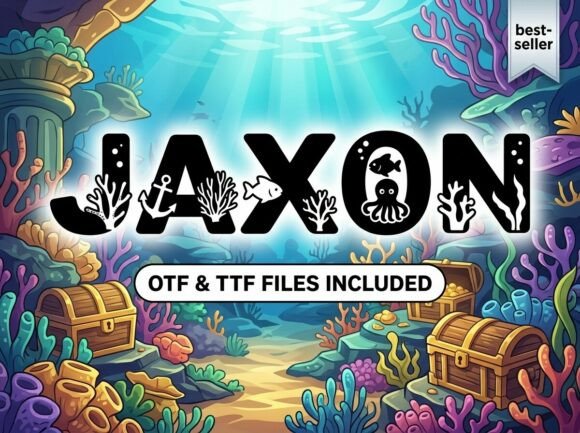
When evaluating display typefaces, the distinction often lies in the balance between visual impact and thematic specificity. Jaxon occupies a unique niche as a bold, high-impact sans-serif that functions as more than just a set of letters; it acts as a canvas for intricate underwater illustration. Unlike standard serif or sans-serif fonts that prioritize readability in body text, Jaxon is engineered for headers, logos, and branding elements where the visual metaphor is as important as the text itself.
The font features solid black letterforms, which provide a heavy, grounded foundation. This weight is essential because it allows the internal negative space of the letters to host complex artwork—such as coral reefs, anchors, and marine life—without making the text difficult to parse. For designers working on projects ranging from children’s aquarium branding to summer vacation graphics, understanding this structural integrity is the first step in determining if Jaxon fits the project scope.
Aesthetic Appeal vs. Functional Versatility
The primary strength of Jaxon is its thematic clarity. The clean, rounded silhouette of the letters immediately conveys a friendly and adventurous tone. This makes it an exceptional choice for contexts where immediate emotional recognition is required, such as marine conservation posters or beach-themed apparel. However, this specificity is also its primary constraint. While a geometric sans-serif font can be adapted for corporate reports, tech startups, and minimalist posters, Jaxon’s illustrated nature anchors it firmly to nautical, summer, and playful themes.
When comparing Jaxon to other decorative display fonts, consider the "replay value" of the design. A generic bold font offers infinite versatility but requires more design effort to inject personality. Jaxon delivers high personality out of the box but limits the designer to a specific aesthetic lane. If your project requires a cohesive look across diverse materials—from a sea-life exhibit logo to a fun party header—Jaxon provides that consistency. If the project involves mixed messaging where the tone shifts from serious to playful, a more neutral typeface might be a safer foundation.
Evaluating Tradeoffs in Visual Hierarchy
In design, hierarchy is established through contrast. Jaxon creates hierarchy through complexity and weight. Because the letterforms are bold and detailed, they naturally dominate a layout. This is a significant advantage when creating focal points, such as a hero section title or a book cover. However, this dominance creates a tradeoff regarding background elements.
Designers using Jaxon must be cautious about "visual noise." If the background of a poster or website is already textured or features detailed photography, the intricate illustrations within the letters of Jaxon might clash, resulting in a cluttered appearance. In such scenarios, a simpler, solid sans-serif might be a better alternative to ensure legibility. Conversely, if the layout is clean and minimal, Jaxon can serve as the primary visual element, reducing the need for additional graphics or imagery.
Comparison with Standard Illustrated Fonts
It is useful to compare Jaxon against two broader categories: standard novelty fonts and high-end display typefaces.
- Standard Novelty Fonts: Many novelty fonts feature illustrations but often lack the structural integrity of a professional typeface. They may look jagged at small sizes or become illegible when colored. Jaxon appears to prioritize the "solid black letterform" structure, which suggests better scalability and color versatility than low-quality novelty options.
- High-End Display Typefaces: Premium display fonts often focus on stylistic flair, such as extreme ligatures or art deco geometry. Jaxon differentiates itself by focusing on content integration—embedding objects inside the letters. This is a distinct approach that differs from purely stylistic fonts, offering a different kind of value for specific branding needs.
Best-Fit Scenarios for Jaxon
Determining if Jaxon is the "right" choice depends heavily on the target audience and the medium. For adults designing for children or family-oriented events, the rounded, friendly aesthetic is a strong psychological fit. It avoids the harshness of sharp, angular fonts, which can sometimes feel aggressive or overly corporate.
Consider the following practical applications where Jaxon shines:
- Event Branding: For a beach party, a marine biology summer camp, or a coastal resort, Jaxon can instantly set the mood in invitations and signage.
- Merchandise: On apparel like t-shirts or tote bags, the bold black shapes hold up well to printing processes, and the internal details add a layer of interest that catches the eye.
- Packaging: Products related to bath toys, seafood seasonings, or summer snacks can benefit from the whimsical, illustrative quality of the font.
Limitations and Alternative Approaches
While Jaxon is a compelling option, it is not a universal solution. If the design project requires long-form readability, such as a website paragraph or a brochure body text, Jaxon should be strictly avoided. Its high-impact nature is designed for short bursts of text, typically one to five words.
Furthermore, if the branding requires a more "serious" take on marine themes—such as a deep-sea exploration documentary or a high-end seafood restaurant—Jaxon might skew too juvenile. In these cases, a sophisticated serif font paired with separate, high-quality stock illustrations of marine life might offer a more mature aesthetic. This approach separates the typography from the imagery, allowing for greater control over the tone.
Technical Considerations
When implementing Jaxon in digital formats, file size and rendering can be factors. Illustrative fonts often have larger file sizes than simple vector-based sans-serifs because of the complexity of the glyphs. While this is rarely an issue for static logos, it is worth noting for web designers optimizing for load times. However, for static graphics and print, this is generally a non-issue.
Conclusion: Making the Decision
Choosing a display font like Jaxon is about aligning the tool with the creative vision. It is not merely a typeface but a design element that carries its own narrative weight. If your goal is to evoke the vibrant life of the ocean floor with a bold, adventurous, and friendly character, Jaxon offers a cohesive solution that saves time on illustration integration. However, if your project demands versatility, subtlety, or a serious tone, exploring cleaner sans-serifs or elegant serifs paired with separate graphic elements will likely yield a more adaptable result. By weighing the thematic specificity of Jaxon against the need for broad applicability, you can make a more informed choice that enhances your visual communication.