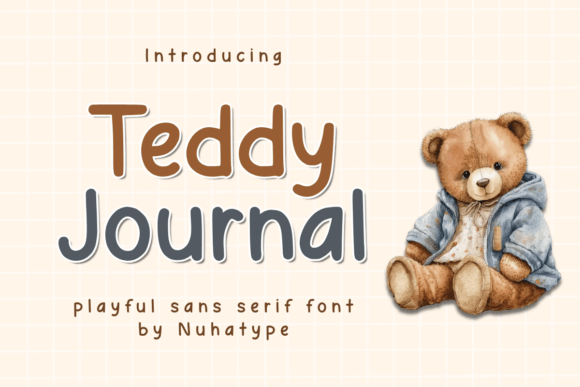
Teddy Journal: Evaluating a Handwriting-Inspired Font for Modern Crafts
When selecting a typeface for creative projects, the choice often goes beyond mere aesthetics. It involves a practical evaluation of how a font performs across different mediums, how it communicates a specific mood, and how it aligns with the functional requirements of a project. The Teddy Journal font has emerged as a notable option in the realm of handwritten-style typefaces. It is characterized as an elegantly minimalist, thin sans serif font that aims to capture the charm of natural handwriting without the inconsistencies of manual script. This article provides a balanced examination of Teddy Journal, exploring its core characteristics, ideal applications, and the trade-offs involved in choosing it for your work.
Understanding the Core Characteristics of Teddy Journal
Teddy Journal distinguishes itself through a specific design philosophy. Unlike many script fonts that mimic cursive or elaborate calligraphy, it adopts a simplistic allure. Its thin, sans-serif construction ensures high legibility, even at smaller sizes, which is a critical factor for functional items like planners and labels. The font's design intentionally avoids the overwhelming flourishes common in decorative typefaces, positioning it as a versatile tool rather than a standalone artistic statement. This minimalist approach allows it to complement a wide range of visual elements without competing for attention, making it a practical choice for layered designs.
How Teddy Journal Compares to Other Handwritten Styles
Within the broad category of handwriting-inspired fonts, there is significant variation. Some fonts are bold and expressive, suited for large headings or logos. Others are highly irregular, mimicking the raw feel of a quick note. Teddy Journal occupies a middle ground. Compared to a bold, swirly script, Teddy Journal offers greater clarity and a more modern, clean feel. When measured against a rough, sketch-style font, it provides more consistency and predictability. This makes it less suitable for projects that demand a rugged, artisanal look but highly effective for designs that require a personal touch with a polished, contemporary finish. It’s a font that suggests careful thought and neatness rather than spontaneous emotion.
Practical Applications: Where Teddy Journal Excels
The true test of any typeface is its performance in real-world applications. Teddy Journal has been widely adopted in several creative and commercial niches, each leveraging its unique strengths.
- Planners and Journals: This is arguably its namesake and primary strength. The font's readability and gentle aesthetic make it ideal for headings, subheadings, and inspirational quotes within daily, weekly, or monthly planners. It adds a personal, handwritten feel without sacrificing the organizational clarity these products require.
- Interior KDP and Printables: For low-content book interiors, such as notebooks, diaries, and activity books, Teddy Journal provides a cohesive and inviting look. Its thin lines work well in grayscale printing, avoiding the heavy ink coverage that can bleed through pages.
- Cricut Creations and Vinyl Projects: The font's clean, thin strokes are generally favorable for cutting machines. Simpler letterforms with minimal intricate details tend to cut and weed more cleanly, reducing material waste and production time. It is particularly effective for creating elegant labels, monograms, and quotes for tumblers, mugs, and tote bags.
- Digital Design and Stickers: In the digital realm, Teddy Journal is useful for social media graphics, digital planners, and printable sticker sheets. Its minimalist style ensures it remains legible across various screen resolutions and when scaled down for small sticker text.
Evaluating the Trade-Offs and Limitations
No font is perfect for every situation, and Teddy Journal has inherent trade-offs that should inform your decision. Its primary limitation stems from its core design: the thin, delicate strokes. While elegant, these strokes can pose challenges in certain contexts.
For instance, on very textured or uneven surfaces—like rough ceramic mugs or heavily woven tote bags—ultra-thin lines may not adhere as well during the vinyl application process or may become difficult to read from a distance. In such cases, a font with slightly thicker, more robust strokes might be more durable and visually impactful. Furthermore, for projects that require a strong, bold statement—such as a large headline on a poster or a prominent logo—Teddy Journal's subtlety might be perceived as lacking presence. It is designed to whisper, not shout, so pairing it with a bolder complementary font is often necessary for hierarchical designs.
Is Teddy Journal the Right Choice for Your Project?
Making an informed decision involves matching the font's properties to your project's goals. Teddy Journal is likely an excellent choice if your priorities include:
- Clarity and Legibility are paramount, especially in text-heavy applications or at small sizes.
- You are aiming for a modern, minimalist, or Scandinavian-inspired aesthetic.
- Your project involves layering text with other design elements and you need a font that won't overwhelm the composition.
- You are working with digital cutting machines and value clean, easy-to-weed designs.
Conversely, you might need to explore alternatives if your project demands a bold, high-impact visual, a highly rustic or vintage feel, or if the final product will be viewed primarily from a long distance. In those scenarios, fonts with greater weight, more pronounced texture, or larger x-heights would be more appropriate.
Integrating Teddy Journal into a Broader Design Workflow
For most designers and crafters, a single font is rarely the answer. The key is understanding how Teddy Journal functions within a typographic ecosystem. It pairs exceptionally well with clean, geometric sans-serif fonts for a harmonious, modern look. It can also provide a soft contrast to a structured serif font, adding a touch of warmth to an otherwise formal layout. When using it for product-based designs, always conduct test cuts and prints. Check the legibility of your chosen text at the actual size it will appear, and assess how it interacts with the physical material of the end product, whether it's paper, vinyl, or fabric.
In summary, Teddy Journal presents a compelling option for creators seeking a balance between personal charm and functional simplicity. Its strength lies in its versatility across a range of planner, journal, and craft applications where clarity and a minimalist aesthetic are valued. By understanding its distinct thin-stroke profile and comparing it honestly against the specific demands of your project, you can determine if it is the right tool to bring your vision to life. Thoughtful selection, always, trumps following trends.